
Why, after this analysis, I believe in SpaceX’s astronomical valuations
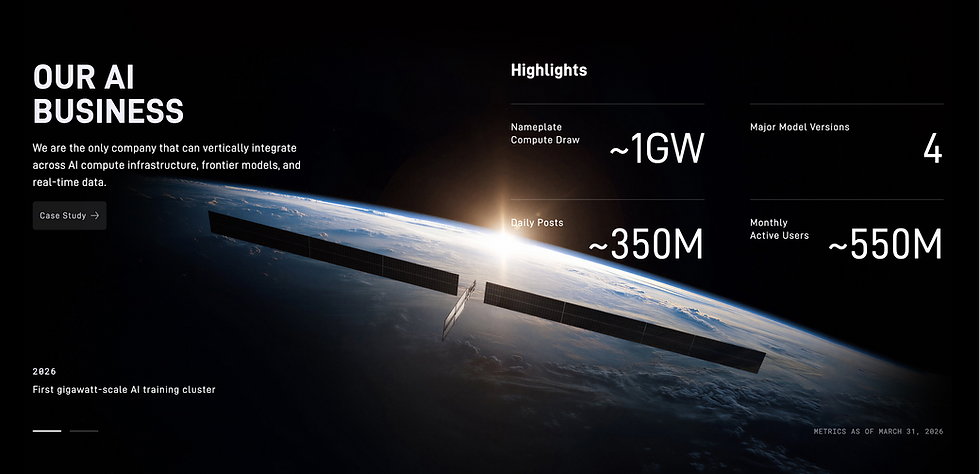
The valuations signed off by Goldman Sachs and Morgan Stanley.
For over thirty years, I've observed market trends before they unfold. Rarely has a single figure captured my attention like this one: 1.25 billion dollars monthly. That’s what Anthropic will pay SpaceX for the Colossus I and II supercomputers in Memphis until May 2029. This amounts to about 15 billion annually, potentially reaching 45 billion in total. This figure wasn't announced in a press release; it was hidden in the S-1 SpaceX filed with the SEC.
Upon reading it, I understood why Goldman Sachs and Morgan Stanley value this company at 1.77 trillion dollars, marking the largest IPO in history. However, I must be honest: this conclusion is based on uncomfortable facts.
First, the uncomfortable part
The S-1 isn't a love letter. The merged company—SpaceX absorbed xAI in February 2026, and xAI had already integrated X—has an accumulated deficit exceeding 41 billion dollars. Additionally, Grok, the model for which Colossus was built, lost users and dropped to fifth place, behind Claude, Gemini, and DeepSeek.
Some analysts view this as a surrender: xAI supposedly built massive compute capacity for a Grok demand that never materialized. This is where my interpretation diverges. The absence of demand turned out to be good news for the company. The capacity that Grok didn't need was used to meet external AI compute demand, such as Anthropic’s, which is willing to pay 15 billion annually. What seemed like excess became a lucrative business model, validated by solid numbers and a signed contract, supporting SpaceX's very structure.
Why renting to Anthropic seems like the best news, not the worst
The fact that a direct competitor like Anthropic commits 45 billion for Musk’s compute capacity indicates something no PowerPoint can replicate: the hardware has genuine market value, determined by AI experts. When an asset previously “underutilized” is monetized at 15 billion annually, it transforms from a liability into a revenue source—with the caveat that the contract can be canceled with 90 days’ notice, making it a valuable option rather than a guaranteed annuity.
Here is my main thesis. I am not valuing Grok. I am valuing a platform with three distinct engines:
• Starlink, the cash engine: the satellite internet business already generating billions and expanding.
• Launches, the near-monopoly: the infrastructure reinvests each dollar into Starship.
• AI compute: now with proven external demand and potential for orbital data centers—Anthropic has shown interest in this area.
Three businesses with contrasting financial profiles, unified under one entity. The challenge isn't the number; it's believing in the future it represents.
The arithmetic, no smoke
I’m not promising four-digit returns. The income from Anthropic doesn't make the AI division profitable; it offsets losses while Starlink generates cash. The key is the revenue trajectory of the combined platform.
My base case—100 billion in revenue by around 2030 from launches, Starlink, and compute—is conservative compared to the underwriting banks: Morgan Stanley projects about 160 billion for 2028, and Goldman exceeds 470 billion for 2030. At 1.77 trillion, the market currently values the company at nearly 90 times current sales, but only a high single digit based on projected sales three to four years ahead. That’s the gamble.
Is it aggressive? Certainly. Aswath Damodaran’s discounted cash flow model suggests a fair value closer to 1.22 trillion—a reminder that the offering price assumes significant faith in execution.
My conclusion
I trust the astronomical valuations from Goldman and Morgan Stanley not despite the analysis, but because of it. Not because today’s numbers justify them—they don’t—but because it's rare for a growing cash engine, a near-monopoly in infrastructure, and an AI asset validated by the market’s most demanding competitor to converge in one company. The market isn’t pricing the present; it’s pricing optionality. Historically, that’s the bet that has paid off for those able to discern conviction from euphoria.
As a financial advisor with over 30 years of guiding families through long-term decisions, I see SpaceX as one of those rare opportunities where technological conviction meets industrial execution.
DISCLAIMER
This article represents my personal opinion and independent analysis. It does not constitute investment advice, a recommendation, or an offer to buy or sell securities. Projections and opinions may change. Invest only after consulting your registered financial advisor and conducting your own due diligence. LifeInvest Wealth Management, LLC is an investment advisory firm registered with the SEC. Past results do not guarantee future results.
Esta presentación se hace únicamente con fines informativos y no debe interpretarse como una oferta para vender o como una solicitud de comprar cualquier producto o servicio que se menciona. Este canal informativo solo está dirigido a su destinatario y no podrá distribuirse sin previo consentimiento por escrito de LifeInvest Wealth Management, (“LifeInvest”).


Comments