
Are We in a Bubble? The Answer Is in the Earnings
It is the question of the season. You hear it in boardrooms, over dinner and on trading floors: are we in a bubble?
The best answer comes from the data. The September 2026 State of Markets report from a16z, as the Silicon Valley venture capital firm Andreessen Horowitz is known, takes it on across 90 slides. One point of context: a16z discloses that it holds positions in some of the companies it cites.
Its underlying thesis is that technology is now in everything. According to a16z, every company today is, in some sense, a tech company, and the largest, most profitable and fastest-growing companies the world has ever known are tech companies. Let us take the numbers theme by theme.
Earnings, not prices
a16z sums it up in a slide titled "Hard To Call It A 'Bubble'". The argument is simple: the market keeps setting new highs, but it is profits, not prices, doing the work.
Year to date, according to the report, the S&P 500 is up 12.7%. Earnings per share are up 27.7%. And the price-to-earnings multiple has contracted 11.7%. Companies are making money faster than their shares are rising.
In tech, the pattern is sharper still. The sector is up 22.1%, earnings per share have grown 55.7% and the multiple has come down 21.6%. a16z puts the tech multiple 19% below its five-year average. And that growth comes off an already high base of profits.
It is the best possible signal. The advance rests on income statements.
AI demand you can measure
The second question is whether there are customers behind all this investment. According to a16z, there are, and at a scale never seen before.
The report estimates that OpenAI and Anthropic will bring in about $100 billion of revenue in 2026, against $63 billion for all of public software, excluding cloud. Two labs generating, in a single year, more revenue than an entire industry. a16z calls revenue growth of this speed and scale unprecedented.
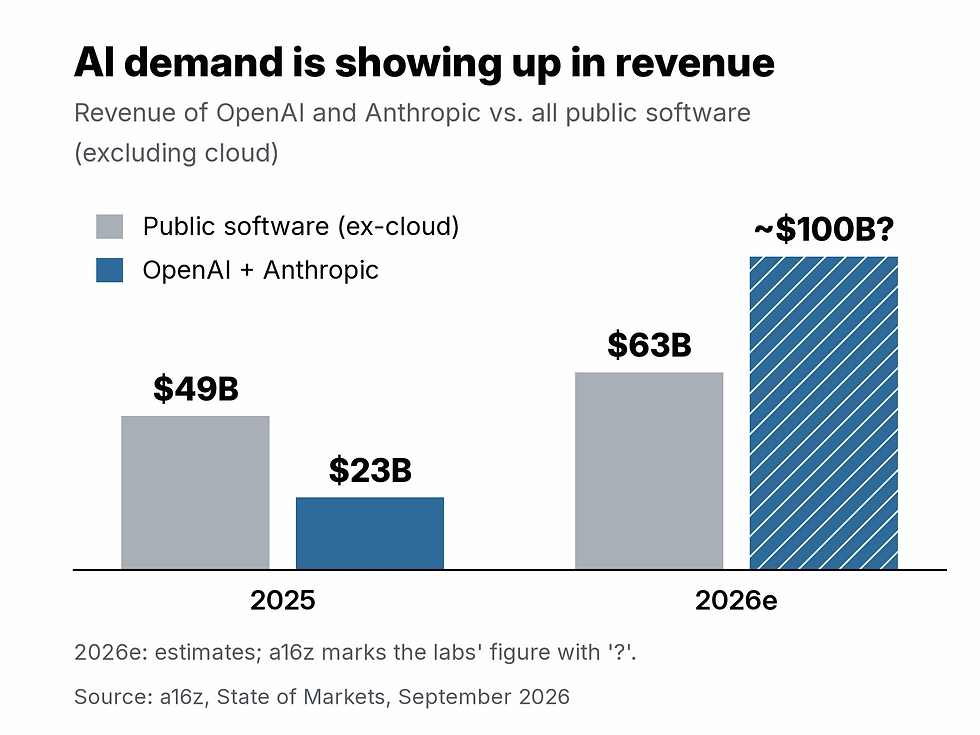
The cloud confirms the trend. According to the same source, revenue backlogs at the big providers are growing at around 150% a year. Demand is running ahead of supply.
Capex and financing: the number to watch
If one variable deserves close attention, it is investment. It is also the one building the future.
According to the report, capital spending by Alphabet, Amazon, Meta, Microsoft and Oracle went from $416 billion in 2025 to an estimated $777 billion in 2026. Consensus puts it at $1.1 to $1.2 trillion a year from 2027 to 2030.

Debt markets have stepped in to help fund it: a16z puts new investment-grade issuance by those companies and Nvidia at more than $300 billion in 2026. The report stresses that their return on invested capital remains well above their cost of borrowing, and the forecasts it cites point to a strong rebound in free cash flow from 2028.
It is also investment that builds productive capacity: data centers, chips, power and networks. According to the report, the AI infrastructure buildout accounts for all or nearly all net-new construction spending and recent blue-collar job growth.
This is the number worth watching, and the one that best captures the ambition of the cycle. According to a16z, every compute cycle has been bigger than the last: from mainframe to PC, from the internet to cloud and mobile. The AI era is shaping up to be the largest.
Private markets: liquidity and scale
Private markets offer another constructive signal. According to PitchBook data cited by a16z, exits of US venture-backed companies reached $2,188 billion in the first half of 2026, against $284 billion in all of 2025. Over the same period, venture funds raised $72 billion.

The scale is also without precedent. According to the report, Anthropic is valued at $965 billion and OpenAI at $852 billion. The five largest private tech companies, led by Anthropic and OpenAI, are together worth $2.2 trillion, more than the $1.73 trillion of every tech IPO of the past decade combined.
The secondary market tells the same story. According to a16z, the median trade clears at no discount to the last round: 0%. The best companies trade at a premium.
Venture: the manager makes the difference
In a cycle like this, choosing well is what creates value. For funds of the 2024 vintage, according to Carta figures cited by a16z, the top decile shows a net IRR of 40.5%, while the median stands at -3.3%. The report notes that the gap between the best and the rest has never been wider.
The reading is constructive: the value is there, and manager selection is what captures it.
The backdrop: a generational shift
Back to the opening question. The a16z figures describe something else: a generational shift. Technology is no longer a sector. According to the report, tech companies generate nearly half of the S&P 500's profits and account for about 76% of its earnings growth this year. Since 2010, their earnings have grown roughly 3.8 times more than those of the rest of the index.
Earnings growing faster than prices. AI demand measured in tens of billions. Investment that builds productive capacity. And venture capital finding liquidity again.
Great cycles never move in a straight line, but the direction is clear. That is good news for anyone who thinks in decades rather than quarters.
Technology is now in everything. And we are only at the beginning.


Comments