
Oil: From the Hormuz Shock to a Possible 2027 Glut
What to expect in the second half of 2026 — according to the agencies, the banks, and Goldman Sachs' latest analysis
The oil market enters the summer of 2026 with one question dominating trading desks: how far can crude fall as the conflict between the United States and Iran winds down? After months of an unprecedented supply shock tied to the closure of the Strait of Hormuz, the interim agreement reached this week — a 60-day ceasefire that allows Iran to export and gradually reopens the strait — has shifted the market's tone from stress to normalization.
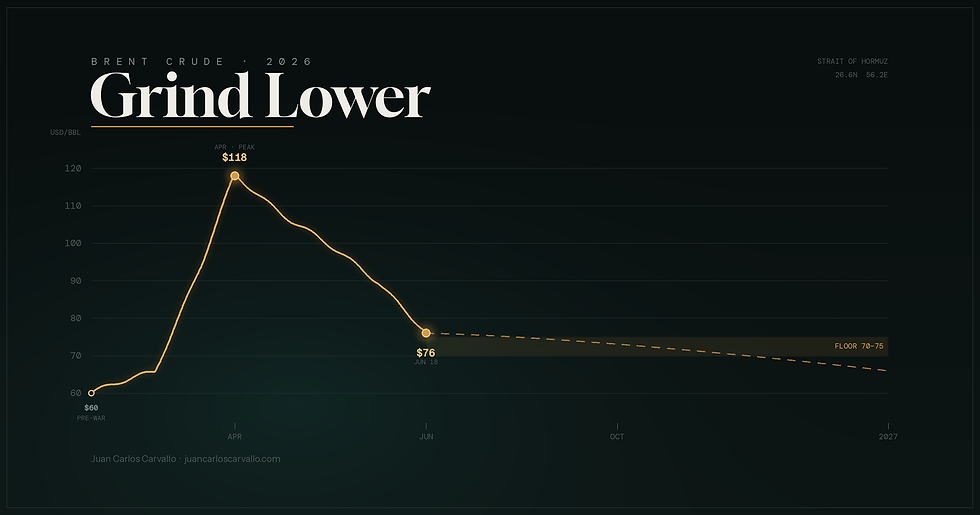
Brent was trading at roughly $76 per barrel on June 18, well below its April peak near $118 during the war, but still above the ~$60 where the year began. WTI has fallen about 29% since the first ceasefire was announced in April. For now, the direction is lower.
The analysis shaping the conversation
In its latest market note, Goldman Sachs captures the moment with a phrase that has become a reference point: prices are likely to "grind lower." Jerome Dortmans, co-head of Global Oil and Products Trading at the bank, argues that the bulk of the price move is "probably priced in," and that oil has entered a different paradigm, heading toward a healthier balance.
The nuance matters: Dortmans does not foresee an immediate collapse. He expects that, in this initial phase, Brent will find a floor around $70–$75, supported by sharply depleted global inventories that will need rebuilding and by the third-quarter seasonal ramp-up in gasoline and diesel demand across the northern hemisphere. But he notes that some institutional positioning already points to $50–$60 "pretty quickly" if the conflict resolves and crude surpluses build at speed. His warning to producers: prices that low could reverse the production gains of recent months, particularly among high-cost producers.
What the agencies say
The three major reference bodies agree on the underlying diagnosis — battered supply, weakened demand, inventories at lows — but differ on magnitude.
The International Energy Agency (IEA), in its June report, cut its 2026 global demand forecast by a further 700,000 b/d: it now projects a contraction of ~1.1 mb/d for the year. It estimates global supply will fall by some 3.9 mb/d to ~102.4 mb/d in 2026, with inventories drawing at a record pace (observed stocks fell 143 million barrels in May, equivalent to 4.6 mb/d). Flows through Hormuz are already recovering: from a May low of 9.6 mb/d to about 12 mb/d in early June. For 2027 it anticipates a radical turn: supply rising ~8 mb/d, generating a substantial surplus.
OPEC, in its June Monthly Oil Market Report, again trimmed its 2026 demand-growth forecast to ~0.97 mb/d (from 1.17 mb/d), but — true to its more optimistic view — raised its 2027 projection to ~1.73 mb/d, underpinned by China and India. OPEC+ production averaged 33.13 mb/d in May, with Iran posting the largest decline. One structural shift worth noting: the United Arab Emirates left OPEC and OPEC+ on May 1.
The U.S. EIA shares the read: weak demand in 2026 and elevated near-term prices driven by inventory draws, followed by normalization.
What the banks say
Following progress in the negotiations, the Wall Street houses revised their forecasts lower:
J.P. Morgan holds the most bearish view: Brent averaging ~$60/bbl in 2026, citing soft supply-demand fundamentals.
Morgan Stanley cut its Brent forecast to ~$90 in Q3 (from $100) and ~$80 in Q4 of 2026 (from $95), with prices supported at or above $80 into 2027.
Goldman Sachs, in its research note, lowered its Q4 2026 Brent forecast to $80 (from $90) and its 2027 average to $75 (from $80), bringing forward to late July the return of Gulf exports to pre-war levels. The bank projects a ~3.2 mb/d surplus in 2027 but expects crude to hold near its long-term fair value ($75 Brent / $70 WTI), with a "security premium" keeping a floor under prices.
What to expect in the second half of 2026
Near term (summer). High volatility. Peak seasonal demand, low inventories, and any delay in mine-clearing or production ramp-up can trigger temporary spikes. Consensus places Brent in a wide $70–$90 range, with a bias toward the upper end while Gulf supply has yet to fully normalize.
Medium term (into 2027). If Hormuz flows resume gradually — the base case in most models — supply recovers with a lag: a possible temporary deficit followed by a significant surplus in 2027. The combination of rising non-OPEC supply (the U.S. set a record of 21.9 mb/d of total liquids in April; Brazil, Kazakhstan, Canada, and Venezuela are also adding) and demand weakened by high prices points to lower prices next year.
Two-sided risks
The base case — normalization and a possible glut in 2027 — is not the only scenario:
Upside: a geopolitical re-escalation, attacks on tankers, or a breakdown in nuclear talks that leads Iran to close the strait again. Goldman estimates that if the Hormuz disruption persists into 2027, Brent could exceed $130 by late 2026 and average ~$105 next year.
Downside: a swift resolution combined with strong non-OPEC production would accelerate the surplus and pressure prices toward $50–$60.
Wild card: the Russia-Ukraine war. Fresh sanctions on Russian crude would tighten supply; a peace deal, conversely, would return barrels to the market.
Implications for investors
For those of us managing portfolios, the current regime — supported prices but with a downward bias and high volatility — carries concrete read-throughs. Energy exposure should be assessed with an eye on the transition from deficit (2026) to potential surplus (2027), an environment that has historically compressed margins for high-cost producers. The crude trajectory also remains a first-order variable for inflation and, by extension, for the path of interest rates. In this context, hedging and income strategies (for example, covered calls on energy positions) are worth revisiting in light of volatility that will likely stay elevated through the summer.
The practical recommendation is to watch the next IEA and OPEC reports closely, along with Hormuz headlines: in this market, the day's headline still moves the price.
This article is provided for informational and educational purposes only. It does not constitute investment advice, nor a recommendation to buy or sell any financial instrument, and does not take into account the objectives, financial situation, or particular needs of any investor. The projections cited belong to their respective sources and are subject to change. Consult your financial advisor before making investment decisions.
Sources: Goldman Sachs (Global Banking & Markets; Global Investment Research), IEA (Oil Market Report, June 2026), OPEC (MOMR, June 2026), J.P. Morgan Global Research, Morgan Stanley, EIA. Data as of June 18–19, 2026.


Comments