

Oil for a hundred years: what a U.S. lease in Venezuela would mean — and how it compares with Chinese enclaves
Updated: Aug 30
VENEZUELA · UNITED STATES · CHINA
Updated August 30, 2026.
Delcy Rodríguez, former executive vice president and de facto interim president of Venezuela, said on Saturday in a televised address that the binational project with the United States is “signed for 25 years.” Seventeen fields. More than 1.5 million barrels a day. $209.335 billion for the State. The contract is not in the Gaceta.
This article’s headline speaks of a century because that was the leak that opened it. The podium said 25. The century is the other version: Francisco Monaldi, an energy economist at Rice University’s Baker Institute; the Wall Street Journal; the Financial Times, which presents Alejandro Betancourt, the Venezuelan businessman who leads North American Blue Energy Partners, as the United States’ minority partner in the company that would control more than 65 billion barrels.
The comparison with Chinese enclaves still holds as instrument. At 25 years the kinship is of contract. At 100, if the Journal is right, it is Hambantota. The paper has not been seen.
1. What she said on camera
The address lasted about six minutes. Miraflores published the video. This does not rest on a wire.


A forest of derricks on Lake Maracaibo, linked by wooden walkways. Period photograph, late-1920s look.

Satellite view of Lake Maracaibo: the pear shape, the greens of Zulia, and the strait toward the gulf at the bottom of the frame. NASA.
Delcy Rodríguez, August 29, 2026, Miraflores Palace.
She said, in the parts that matter:
A binational project “signed for 25 years.” Seventeen fields. A target of more than 1.5 million barrels a day. $209.335 billion for the State.
A reference price of $65 a barrel. “Around 19 dollars enter our country directly” per barrel.
Eight green blocks in the Orinoco Belt, with minimum royalties of 16 percent and income tax of 34 percent. The contrast she herself offered: thirty years ago, four green blocks with a 1 percent royalty and 34 percent income tax.
She thanked Donald Trump and Marco Rubio. She named Chevron, Repsol, Eni, Shell and BP as other agreements, not as the 17-field package.
The sovereignty sentence: “Venezuela retains ownership and sovereignty over its resources, while using capital, technology and operating capacity to leverage the recovery of a strategic industry hard hit by sanctions.”
The diplomacy sentence: “We chose the path of diplomacy with the United States of America to turn our differences into cooperation.”
What she did not say on the podium: 65 billion barrels, $100 billion of investment, 55 percent, production-sharing contracts, a 100-year concession, a Gaceta, the Assembly, PDVSA equity, Machado, OFAC. “More than 100 years,” when it appeared, was the workers’ experience. It is not the contract term. Anyone who reads it as a secular lease is reading another speech.
“Signed” is the verb she used. It is not a text in the Gaceta. It is not a contract one can read.
2. The $19 are not the royalty
The podium’s figures should not be mixed.
Delcy Rodríguez said that, at $65 a barrel, “around 19 dollars enter our country directly.” That is the State’s take — what comes into the country — not a royalty. The royalty she herself cited, for the eight green blocks of the Belt, is a 16 percent minimum. Sixteen percent of $65 is about $10.4. It is not 19.
The roughly $19 can include royalty plus income tax — 34 percent, also on the podium — plus other items. The fiscal contrast with the 1 percent of thirty years ago is real. It does not turn 19 into 16, or 16 into 19.
3. The other reading: a century, the Pentagon, NABEP
Hours after the speech, Francisco Monaldi, an energy economist at Rice’s Baker Institute, wrote on X two versions of the same announcement. He does not confirm them. He puts them on the table.
The first: 17 production-sharing contracts. Mixed companies plus undeveloped PDVSA fields. PDVSA as titleholder. The private party operates for a share of output. 25 years. On the green blocks, 16 percent royalty and 34 percent income tax. They do not spell out the rate on fields already in production. A lighter load than last month’s regulation. Little that is new.
The second: 100-year licenses. A U.S. majority, part of it the government. Preferential offtake for the Strategic Petroleum Reserve and the military. The money, from the Department of War. NABEP and Betancourt.
Monaldi does not choose. So which is it, then?
The Wall Street Journal, on 29 August, an hour before the speech, cited people involved in the negotiation.
NABEP would operate. Washington would not drill. The Army does not go down to the Belt. The Energy Department does not either. North American Blue Energy Partners, Alejandro Betancourt’s firm, would be the operator of the 17 fields. The U.S. government, on this account, is not the one lifting the barrel.
The United States would take a passive 35 percent of NABEP and, separately, the right to buy 20 percent of production at cost. Passive: equity without operating control. Offtake at cost: a guaranteed barrel, paid at the cost of lifting it, not at the market price.
The Pentagon’s Office of Strategic Capital would structure the investment with penny warrants: one-cent warrants that deliver equity with almost no capital put in. The Defense Department would end up holding the equity and the purchase rights, not merely a loan.

The Pentagon, Arlington.
The State Department led. OSC came in late. David Lorch, the office’s director, was in Caracas in July. Trump and Rodríguez had allegedly closed the outline on a call days earlier, according to those sources.
The form is a private company on purpose. The design, the same sources say, is meant to bind future governments: the paper would not be an interim decree easy to tear up, but a corporate vehicle with long rights. At 100 years, if that figure survives. Rodríguez, on camera, said 25.
Sean Parnell, the Pentagon spokesman, told Reuters that the Office of Strategic Capital does not take equity stakes in private companies. Its role, he said, is limited to loans, guarantees or technical assistance, including transaction structuring. The White House and NABEP did not respond to Reuters outside business hours. The Journal describes equity via penny warrants. Parnell says OSC does not take equity. The collision stays.
Trump spoke of “majority control” over 65 billion barrels. The Associated Press, citing an anonymous U.S. official, spoke of 55 percent of “effective output” and of an unnamed operator. The Journal speaks of 35 plus 20 and names NABEP. 55 is not 35+20. A passive 35 plus a 20 offtake is not, in reservoir arithmetic, an operating majority. It is not clear how that is managing the oil. It is not clear how it adds up to a majority.
In mid-August, before the 28 August announcement, Harry Sargeant III, a Florida oil businessman and then a minority partner in NABEP, sold that minority — on the order of $300 million — through Bluewave Properties Ltd. to a party close to Betancourt. Treasury had frozen Bluewave and issued a license to divest, according to Bloomberg, El País and EnergyNow. The sale consolidates Betancourt inside NABEP before the announcement. Rodríguez did not mention it.
Schreiner Parker, an analyst at Rystad Energy, told the Journal that if the deal survives subsequent governments, Trump will have secured strategic reserves beyond the shale revolution, and that there is a lot of uncertainty as to how those barrels go from reserves to production, and who puts in the time, effort and money.
Venezuela pumps 1.1 million barrels a day, on par with North Dakota: no immediate gasoline effect.
ExxonMobil and ConocoPhillips, after months of being pushed, remain on the sidelines. The Journal cites security and legal issues.
The substance of the agreement appears to conflict with the 1999 Constitution: the oil belongs to the Republic and cannot be sold.
Diego Arria, a Venezuelan diplomat and former ambassador to the United Nations, told the Journal the operation is “absolutely unconstitutional” because the government is illegitimate: “They are seizing it—there’s no other word for it.”
The Financial Times headlined “Controversial Venezuelan executive courts investors after Trump oil deal.” In the deck, Betancourt appears as the United States’ minority partner in the company that would control more than 65 billion barrels.
Imdat Oner, a Turkish diplomat, former deputy at the embassy in Caracas and a senior fellow at Florida International University’s Jack D. Gordon Institute, said on X, as quoted by the FT, that the deal has a real legitimacy problem because Rodríguez was not elected, and that a future elected government can challenge or renegotiate, especially a century-long commitment.
4. What is not clear
There is no published contract. No Gaceta. No list of fields.
Delcy Rodríguez says 25 years, “signed.” Washington leaks 100 years. Monaldi asks which it is.
How the United States and the Pentagon take part in managing the oil. The Journal says a passive 35 percent plus 20 at cost; the Defense Department holds those rights; NABEP operates. Trump says majority control. AP says 55 percent of effective output. The three tallies do not match. It is not clear how that is managing the oil, or how it adds up to a majority.
Parnell says OSC cannot take equity. The Journal describes penny warrants of equity. There is a legal collision over the mechanism.
Who pays the capex, and on what timetable. Nobody said.
Operator: the Journal names NABEP and Betancourt, citing people involved. Rodríguez did not. AP left it unnamed.
Sargeant sold the minority — some $300 million, Bluewave, a party close to Betancourt; Treasury pushed the divestment. That is a prior consolidation, not Friday’s pact. Bloomberg and El País reported it, not an official communiqué.
The tax rate on fields already in production: Monaldi says they did not clarify it. Only 16 and 34 on the green blocks.
Offtake: the Journal’s 20 percent, AP’s “effective output,” or Trump’s majority? The Strategic Petroleum Reserve and the military as destination come from an anonymous U.S. official.
The authority of an interim government to bind 25 years or 100. Oner, Arria and the 1999 Constitution raise it.
Whether a future elected government can unwind the private vehicle. The Journal says that is why they put it in a company.
The majors: Exxon and Conoco on the sidelines, per the Journal. Chevron had no comment to AP. Do they come in, or stay out in front of a U.S.-backed competitor?
Until those lines have a text, the spine remains a six-minute speech.
5. Why the announcement is even possible
On 3 January 2026 U.S. forces captured Nicolás Maduro and took him to New York on narco-terrorism charges. An interim government remained, de facto headed by Delcy Rodríguez and aligned with Washington. Since then the United States has eased sanctions, taken a direct role in marketing Venezuelan crude, and deposited revenues in U.S. accounts. Trump has said in public that he controls that oil and that with the proceeds — he spoke of more than $13 billion by mid-year — “the war was paid for.”
Production has reportedly already risen on the order of 300,000 barrels a day since Maduro’s departure, according to Bloomberg compilations at the time. That is an operational recovery. The jump now being announced, in one version or the other, is to lock in a package of 17 fields and formalize the rent.
The U.S. Strategic Petroleum Reserve is at a forty-year low. There is war in Iran and pressure on the Strait of Hormuz. Venezuelan crude is a few days from Gulf Coast refineries designed for the heavy oil of the Belt.
6. Hambantota at 25 years, or at 100
The impression of a Chinese enclave does not come from annexation. It comes from a package: credit, a state firm, a long concession, its own infrastructure.
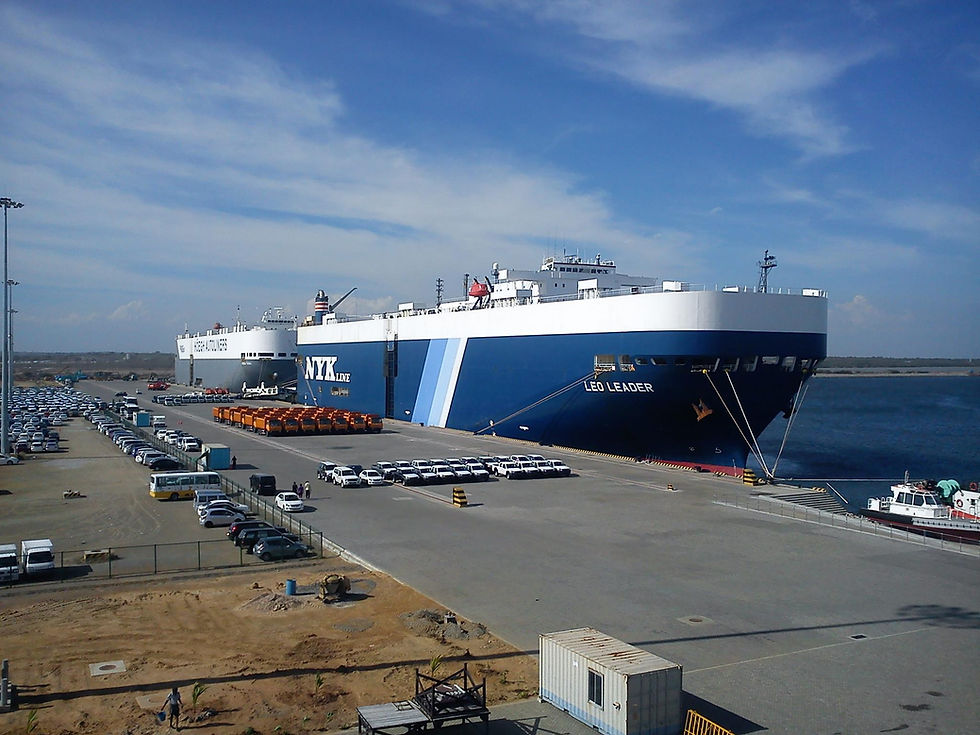
Hambantota port: a commercial terminal.
Hambantota, Sri Lanka, is the most cited case and the most badly told.
In 2017 China Merchants Port took around 85 percent of the operator and a 99-year lease for some $1.12 billion. Sri Lanka remains owner of the port. The real fact is 99 years of exclusive operation. At year 99 the shares return to Colombo for a dollar.
Chancay, in Peru, opened in 2024 by COSCO, changes the commercial geography of the South American Pacific. Sihanoukville, Cambodia, is the case in which the metaphor becomes literal: a Chinese industrial park on someone else’s soil.
The Venezuelan instrument, if the paper exists, looks like that. The political method does not. China arrives as creditor-builder. Washington arrives as the power that has just rearranged Caracas. The useful tension is the term: 25 on the podium, 100 in the Journal.
Dimension | Typical Chinese model | What Rodríguez said | The other reading (Monaldi, Journal, FT) |
|---|---|---|---|
How it arrives | Treaty with the government of the day, plus credit | Speech by an aligned interim government, “signed” | After Maduro’s capture; a Trump–Rodríguez call, per the Journal |
Vehicle | State firm plus a development bank | She did not say | NABEP and the Pentagon’s OSC, per the Journal; Parnell denies it as equity |
Asset | Port, mine, special zone, railway | 17 fields | 17 fields, 65 billion barrels |
Term | 35 to 99 years | 25 years | 100-year licenses, per the leak and the Journal |
Owner of the subsoil | The host state | “Venezuela retains ownership and sovereignty” | U.S. majority, part government |
What is sought | Raw material toward China | Rent to the State (about $19 a barrel of take) | Preferential crude for the SPR and the military; 20% offtake at cost, per the Journal |
Fragility | Resource nationalism and courts | The Constitution and the interim government; no Gaceta | Parnell versus the Journal; AP’s 55% does not match 35+20 |
The most honest analogy is not “China in Cambodia.” It is Hambantota or Chancay: a state uses companies and a kilometer-long contract to sit on an asset the host cannot operate alone. At 25 years, if the paper says what the podium said, the kinship is of instrument, not of century. At 100 years, if the Journal is right, the kinship is tighter. The paper has not been seen.
There is a design irony. For fifteen years Washington denounced “debt traps” and Chinese enclaves. The instrument now under discussion — a long concession, a foreign operator, control of the rent — is a relative. The difference is the signatory on the strong side: not a state firm in a tie, but the government that beheaded the regime.
Another difference favors Washington. China needs to take the concentrate and create value in Guangdong. The United States already has Gulf refineries for Merey and Belt crude. The enclave it wants is financial-commercial: who sells the barrel, to whom, and in which bank the check lands.
7. What this would mean
The contracts and the legal basis are still missing. A Gaceta, an enabling act, a text. Without that, “signed” is a podium verb.
This is better than twenty years of handing the store to Cuba with no return, and to Russia and China with no control. It is not perfect. It is not ideal. It is the best thing in 26 years of chavismo. With the United States there are counterweights. With Havana, Moscow and Beijing, in that stretch, there were none.
That does not turn the Journal into a Gaceta, or the 35 percent in penny warrants into a fact, or the 16 percent royalty into the $19 take.
On Monaldi’s first reading, PDVSA remains titleholder and the private party operates. On the second, the majority is American and part of it is the government. Rodríguez did not say what happens to PDVSA’s equity. An interim government can say “signed.” Whether the paper survives an elected Assembly, a different court, or a sovereignty claim over the subsoil is another war.
Chevron, Repsol, Eni, Shell and BP, on the podium, are other agreements. They are not NABEP.
8. Three scenarios
Scenario A — The paper looks like the podium
A 25-year text appears, 17 fields, production-sharing or something that looks like it, PDVSA as titleholder, 16 percent royalty and 34 percent income tax on the green blocks, State take in the order of $19. It is the most compatible with what Rodríguez said. The constitutional debate stays alive. The Journal’s century stays a leak.
Scenario B — The paper looks like the Journal
A hundred years, NABEP, a passive 35 percent for the Pentagon plus 20 of offtake, a vehicle meant to bind whoever comes next. Maximum signal of U.S. control. Maximum legal vulnerability inside Venezuela. It collides with Parnell, who says OSC does not take equity. It collides with AP’s 55, which is not 35+20. The asset is tied to Rodríguez and to Trump.
Scenario C — Two versions, no contract
That is today’s scenario. Rodríguez spoke. Monaldi described two readings. The Journal put names and percentages. The Financial Times and the White House claim 65 billion barrels. Parnell denies the equity. There is no Gaceta. Until there is a published decree, law or contract, this is the base case.
9. What to watch
Whether the text appears. Without a text there is no deal; there is a podium.
Whether the term is 25 or 100.
Whether the operator is called NABEP or is not named.
Whether the 35 percent in penny warrants survives Parnell, or whether OSC stays at loans and guarantees, as its spokesman says.
Whether AP’s 55 appears, is corrected, or is ignored.
Whether there is legislative enabling or only a decree of the interim government.
How Chevron and the firms Rodríguez named as other agreements react: announced spending, or caution.
Close
China does not own countries. It owns bottlenecks. Where that meets a special zone, the visitor feels he has crossed an invisible customs line.
What is on the table in Venezuela, if it resembles anything Chinese, resembles Hambantota: a long contract over an asset the state cannot put into production alone, signed in an asymmetry of power. It differs in that the strong signatory has just rearranged the palace.
Does the contract leave the subsoil in the Venezuelan state, as Rodríguez said, or turn it into a reserve Washington and its companies can book, as the Journal reads it? At 25 years or at 100? With what reversion clause? Who sells the barrel, and in which account does the check land? Is the 35 percent equity, despite Parnell, or is it not?
Until there is a document, field names, and a decree or law, the spine is a six-minute speech. The rest is version. So which is it, then?
Methodological note
This article draws on Delcy Rodríguez’s televised address of 29 August 2026, published by Miraflores and watched on video; on two readings that Francisco Monaldi, an energy economist at Rice’s Baker Institute, wrote on X hours later; on the Wall Street Journal report “Inside Trump’s Plan to Give the Pentagon a Stake in Venezuela’s Oil Riches” (Vera Bergengruen, Drew FitzGerald, Collin Eaton and Juan Forero, 29 August); on Sean Parnell’s denial to Reuters; on an anonymous U.S. official cited by the Associated Press on 55 percent of “effective output”; and on what the Financial Times published under the headline “Controversial Venezuelan executive courts investors after Trump oil deal,” including Imdat Oner’s remarks. Harry Sargeant III’s sale of a NABEP minority was reported by Bloomberg, El País (17 August) and EnergyNow. The comparison with Chinese enclaves draws on AidData, CSIS and analyses of Hambantota. No government has published the contract. Reserve, take, royalty, investment and production figures are cited as each source stated them, not as an audit. The roughly $19 a barrel are the State’s take, not a royalty; 16 percent of $65 is about $10.4.


Comments